In the fiercely competitive EigenLayer ecosystem of 2026, node runners who top the AVS performance leaderboards aren't chasing fleeting hype; they're building resilient operations that deliver consistent uptime, low latency, and unyielding reliability. As a veteran investor with two decades in the trenches, I've seen enough cycles to know that time in the market beats timing the market, especially when it comes to staking allocations across Actively Validated Services. Climbing those rankings demands a disciplined approach, blending technical precision with strategic foresight. This AVS node runner guide draws from real-world data and operator insights to equip you with performance leaderboard tips tailored for EigenLayer AVS optimization in 2026.

EigenLayer's AVS landscape has matured, with protocols like EigenDA leading the charge in data availability while newcomers like Infura's DIN AVS reshape decentralized infrastructure. Node operators now compete not just on raw stake but on verifiable metrics: uptime above 99.9%, rapid response times, and seamless quorum participation. Dune Analytics dashboards reveal that top performers maintain operator sets with diversified geography and hardware, turning restaked ETH and LSTs into compounded rewards. Yet, the path upward is littered with pitfalls; many falter on outdated runtimes or suboptimal deployments, surrendering leaderboard positions to the prepared.
Decode the Metrics That Drive AVS Rankings
Success starts with understanding what the leaderboards reward. Uptime reigns supreme, but it's uptime fused with performance under load that separates the elite from the pack. EigenLayer's dual quorum model lets AVSs restake flexibly, yet node runners must prove their mettle through transaction processing speed and latency reductions, as highlighted in Bitget Wallet analyses. Transaction volume and user growth metrics guide AVS adjustments, per Blockcrunch insights, but for you, it's about operator-specific scores: response latency under 500ms, zero slash events, and maximal participation in tasks.
Consider EigenDA's mainnet rollout; operators on Hoodi testnet honed setups for rollups, achieving leaderboard dominance by prioritizing single NUMA node deployments to sidestep degradation, much like Cisco's ASAv optimizations. My FRM lens views this as risk management: volatile metrics erode yields faster than market dips. Track real-time dashboards from Dune or AVSleaderboard. com to benchmark against peers. In 2026, with Node. js 24 as the Active LTS darling, ignoring these signals means ceding ground.
Upgrade Runtimes and Stack for 2026 Supremacy
No excuses linger for legacy tech in this era. AWS App Runner's 2024 shift hammered home the cost of delay: Node. js 12 and 14 builds ballooned by 240 seconds, a drag that persists into 2026. Migrate aggressively to Node. js 18 or, better, Node. js 24 for LTS stability, security patches, and predictable updates. This isn't optional; it's the baseline for EigenLayer AVS optimization.
EigenCloud's EigenDA overview underscores live mainnet demands: rollups won't tolerate lag. I've allocated stakes favoring operators who've preempted such shifts, yielding steadier returns amid restaking booms forecasted by Quicknode. Continuous optimization, blending real-world data with simulations as Siemens advocates, accelerates your cycle from setup to leaderboard ascent. Test on Sepolia, refine on Hoodi, deploy globally. Opinion: Skip this, and you're not competing; you're spectating.
Partner with Powerhouses and Nail Deployments
Solo acts rarely summit; leverage established players like Ankr, now the premier node operator for EigenLayer AVS protocols with their high-performance, distributed infra. Their global footprint minimizes latency, a boon for dual quorums where AVSs mix ETH with custom tokens, per Nethermind's EigenDA-ARPA comparisons.
Deployment finesse matters: Cisco's wisdom on ASAv applies broadly; confine VMs to single NUMA nodes to preserve throughput. Infura's DIN AVS exemplifies the marketplace shift, rewarding reliability directly. For home validators, EigenLayer whitepaper notes decentralization perks, but scale demands pros. My take? Hybrid models, blending personal nodes with Ankr-scale backing, optimize risk-reward in this maturing space.
Real-time vigilance separates leaderboard climbers from the rest. Dune Analytics' v0.1.0 dashboard offers a goldmine of performance, economic, and security metrics tailored for EigenLayer restaking. Top operators don't guess; they dissect operator sets, slashing events, and reward distributions daily. In my allocations, I favor those with zero slash history and diversified stakes across AVSs like EigenDA and DIN, where Infura's model ties infra reliability to direct payouts.
Master Monitoring for Sustained Dominance
2026 demands more than setup; it's endless iteration. Siemens' continuous optimization playbook fits perfectly: merge real-world AVS task data with simulations to shave milliseconds off latency. Target Node. js 24's LTS perks for bulletproof stability, then layer in Ankr's distributed nodes for geographic resilience. I've watched operators surge rankings by automating alerts on Dune for uptime dips below 99.9% or quorum lags. Opinion: Treat your node like a bond portfolio; rebalance ruthlessly against macro shifts in restaking yields.
EigenLayer Technical Analysis Chart
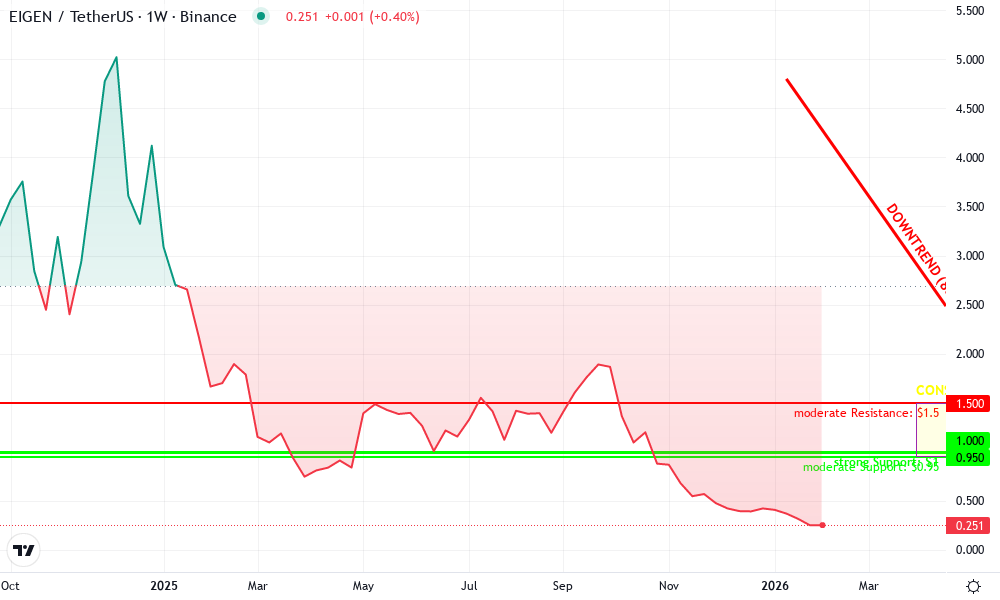
Analysis by David Langford | Symbol: BINANCE:EIGENUSDT | Interval: 1W | Drawings: 5
Technical Analysis Summary
In my conservative style, emphasizing long-term fundamentals over short-term noise, draw a bold red downtrend line from the January 2026 peak to the late spring lows to highlight the dominant bearish channel. Add horizontal support at 1.00 USDT spanning March to September 2026. Overlay a light blue rectangle for the ongoing consolidation zone from April to present. Use green horizontal resistance at 1.50 USDT for the upper bound of recent trading range. Place text annotations for key levels like 'Strong Support - Watch for Hold' at 1.00 and 'Bearish MACD Crossover' near volume spikes. Include callouts on declining volume during the drop and flat volume in consolidation.
Risk Assessment: high
Analysis: Prolonged downtrend, low-volume base risks lower lows amid crypto volatility; fundamentals promising but unproven price confirmation needed
David Langford's Recommendation: No new positions—observe for support hold and AVS metric improvements before considering long-term accumulation
Key Support & Resistance Levels
📈 Support Levels:
- $1 - Multiple tests in consolidation, acting as floor since March crash strong
- $0.95 - Absolute low wick, potential deeper support if breaks moderate
📉 Resistance Levels:
- $1.5 - Upper range of summer consolidation, prior rebound cap moderate
- $2 - Midway retracement from drop, psychological barrier weak
Trading Zones (low risk tolerance)
🎯 Entry Zones:
- $1.05 - Bounce from strong support in low-volume consolidation, only for long-term hold if AVS news confirms high risk
- $0.98 - Deeper support test, high conviction fundamental entry but price risk elevated high risk
🚪 Exit Zones:
- $1.8 - Profit target at resistance confluence 💰 profit target
- $0.9 - Tight stop below key support to limit downside 🛡️ stop loss
Technical Indicators Analysis
📊 Volume Analysis:
Pattern: High on initial drop, declining in consolidation indicating lack of buying conviction
Spike volume February-March confirms distribution, flat bars since suggest apathy
📈 MACD Analysis:
Signal: Bearish crossover persisting into consolidation
MACD line below signal with histogram contracting but negative, no bullish divergence
Applied TradingView Drawing Utilities
This chart analysis utilizes the following professional drawing tools:
Disclaimer: This technical analysis by David Langford is for educational purposes only and should not be considered as financial advice. Trading involves risk, and you should always do your own research before making investment decisions. Past performance does not guarantee future results. The analysis reflects the author's personal methodology and risk tolerance (low).
Ava Protocol's guide nails it: restaking ETH or LSTs secures AVSs, but only flawless execution compounds those layers. Coinbase highlights the dev grind to launch tokens and lure operators; as a runner, you're the prize. Track transaction volume spikes from Blockcrunch signals to preempt load, ensuring your setup thrives in DeFi's restaking surge Quicknode predicts for late 2020s.
Fortify Against Slashing and Scale Quorums
Slashing isn't just a penalty; it's leaderboard kryptonite. EigenLayer's whitepaper empowers AVSs to enforce home validator decentralization, but scaling means mastering dual quorums. Nethermind's EigenDA vs. ARPA breakdown shows flexible restaking unlocks alpha, yet poor configs invite faults. My FRM background screams diversification: split stakes across AVSs, collocate with pros like Ankr, and simulate faults on Sepolia. DIN AVS proves the marketplace rewards uptime; falter, and yields evaporate.
Hardware matters too. Single NUMA node discipline per Cisco prevents throughput cliffs, vital for high-stakes tasks. In 2026, with rollups hammering EigenDA mainnet, operators blending personal ethos with enterprise muscle climb fastest. I've shifted allocations to such hybrids, capturing steadier rewards amid volatility.
Harvest Rewards and Future-Proof Your Edge
Leaderboards aren't endpoints; they're yield engines. Binance dubs EigenLayer crypto's top innovation for good reason: AVSs like those optimizing latency per Bitget turn infra into income. Focus on operator sets with maximal task participation, low latency under load, and geographic spread. Continuous tweaks, Node. js LTS adherence, and Ankr partnerships form the trifecta for EigenLayer AVS optimization 2026.
Picture this: your node, humming on Node. js 24, NUMA-optimized, Dune-monitored, Ankr-backed, powering DIN quorums while raking EigenDA rewards. That's not speculation; it's engineered ascent. As cycles turn, those heeding these performance leaderboard tips - upgrading runtimes, nailing deployments, iterating relentlessly - don't just climb AVS rankings; they anchor the top, compounding restaked capital through 2030. Stake wisely, run relentlessly.



No comments yet. Be the first to share your thoughts!