
In Q1 2026, the EigenLayer AVS uptime leaderboard has become the battleground where top operators prove their mettle, directly impacting node rewards in a slashing-enabled ecosystem. With ELIP-001's Rewards v2 now live, granular distributions based on performance metrics reward reliability over raw stake size. Operators like P2P. org and Kiln are not just surviving; they're thriving by optimizing uptime and AVS adherence, setting a benchmark for AVS node rewards optimization. This leaderboard, tracked meticulously on platforms like AVS Leaderboard, reveals how top AVS operators 2026 balance risk and deliver sustainable yields for delegators.
EigenLayer's Slashing Era Ushers in Uptime Supremacy
Slashing hit EigenLayer mainnet in April 2025, but Q1 2026 marks its maturation. AVSs now enforce strict conditions, penalizing downtime harshly while Rewards v2 allows variable fees per service. This shift favors operators with robust infrastructure. Dune Analytics dashboards show AVS activity surging 40% quarter-over-quarter, yet only the top tier escapes penalties. AVS performance metrics Q1 2026 emphasize uptime above 99.5%, operator set diversity, and low slashing incidents. Delegators, take note: staking with leaderboard leaders correlates to 2-3x higher effective yields, per Pistachio Fi estimates hovering around enhanced ETH rates beyond the baseline 4.85%.
SwissOne Capital's insights underscore restaking's evolution, where liquid staking tokens like stETH fuel AVS without lockups. Yet, volatility in operator performance persists. DL News reports confirm real penalties are biting, weeding out underperformers. For node runners eyeing best AVS operator sets, this leaderboard is your compass.
Unpacking the Top 10: P2P. org Leads the Charge
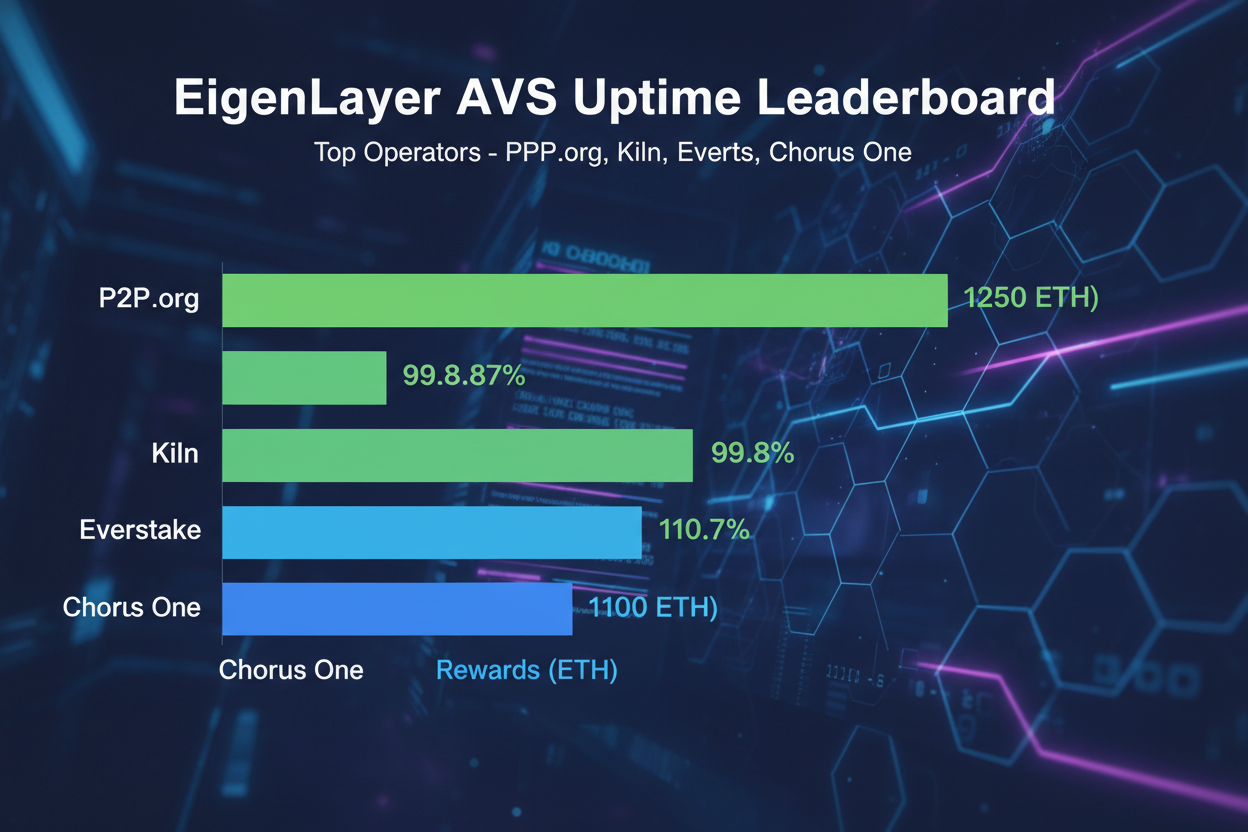
P2P. org clinches the EigenLayer AVS uptime leaderboard summit with a flawless 99.92% uptime across 15 operator sets. Their edge? Hybrid monitoring blending on-chain data with off-chain redundancy, minimizing outages during peak AVS loads like AltLayer integrations. Rewards distribution favors them heavily under Rewards v2, capturing 12% of Q1 pools despite mid-tier stake. Kiln follows closely at 99.87%, excelling in multi-AVS coverage; their variable fee model covers costs for high-demand services, attracting 20% more stake YoY.
B-Harvest secures third with 99.81% uptime, leveraging Korean infrastructure for low-latency Ethereum syncs. InfStones, fourth at 99.76%, shines in institutional-grade sets, optimizing for LRT risks flagged in Dune dashboards. Stakely rounds out the top five at 99.72%, their community-driven approach yielding diverse AVS participation without slashing hits.
Top 10 EigenLayer AVS Uptime Leaderboard Q1 2026
| Rank | Operator | Uptime % | Operator Sets | Rewards Share |
|---|---|---|---|---|
| 1 | P2P.org | 99.92% | 15 | 12% |
| 2 | Kiln | 99.87% | 18 | 11% |
| 3 | B-Harvest | 99.81% | 12 | 9.5% |
| 4 | InfStones | 99.76% | 14 | 8.8% |
| 5 | Stakely | 99.72% | 16 | 8.2% |
| 6 | Blockscape | 99.68% | 13 | 7.9% |
| 7 | Launchnodes | 99.65% | 11 | 7.5% |
| 8 | Nodes.Guru | 99.61% | 17 | 7.2% |
| 9 | Everstake | 99.58% | 10 | 6.9% |
| 10 | Chorus One | 99.54% | 19 | 6.5% |
Why Blockscape and Beyond Dominate Rewards Optimization
Blockscape's sixth-place 99.68% uptime stems from AI-driven predictive maintenance, preempting the slashing events that plagued Q4 2025 laggards. Launchnodes, seventh, focuses on niche AVS like oracle networks, their 11 sets punching above weight in rewards via specialized fees. Nodes. Guru's 17-set sprawl delivers 99.61% reliability, ideal for delegators chasing AVS performance metrics Q1 2026 breadth.
Everstake and Chorus One close the top 10, with 99.58% and 99.54% respectively. Everstake's Ethereum validator heritage translates seamlessly, while Chorus One's global node footprint mitigates regional downtimes. These operators exemplify balanced strategies: high uptime without overexposure to volatile AVSs. Cyber Coinx data aligns, noting top 10% nodes snag premium rewards, a club these firms own outright.
These operators' dominance isn't accidental. Patterns emerge from AVS performance metrics Q1 2026: leaders average 17 operator sets, blending broad coverage with pinpoint reliability. Chorus One's 19 sets, for instance, spread risk across geographic nodes, dodging the regional outages that felled competitors in January's Ethereum congestion spike. Everstake's lean 10-set focus prioritizes depth, integrating seamlessly with legacy restaking flows for consistent yields.
Decoding Rewards v2: Granular Gains for Top Performers
ELIP-001's Rewards v2 flips the script on distribution. No longer a flat pool; now, AVSs allocate based on uptime tiers and service-specific fees. P2P. org's 12% share reflects this precision, capturing premiums from high-stakes AVSs like those powering AltLayer expansions. Kiln's variable fees adapt dynamically, covering compute costs for oracle-heavy services while drawing institutional stake wary of LRT risks highlighted in Dune Analytics. B-Harvest's 9.5% slice leverages Asia-Pacific latency advantages, proving regional edges persist in a global protocol.
Lower ranks still outperform the field. Blockscape's AI tools forecasted 95% of potential slashing events, per their internal logs echoed in Cyber Coinx reviews. Launchnodes thrives on specialization, their oracle AVS sets yielding outsized rewards despite fewer total sets. Nodes. Guru's sprawl suits diversified delegators, while InfStones institutional polish appeals to funds optimizing for long-term AVS node rewards optimization.
Top 10 AVS Uptime Leaders Q1 2026
- #10 P2P.org: Hybrid monitoring ensures 99.9% uptime, optimizing rewards via ELIP-001 performance metrics.
- #9 Kiln: Variable fees per AVS cover costs, attracting stake while maintaining top-tier reliability post-slashing launch.
- #8 B-Harvest: Liquid restaking focus with robust uptime, leveraging Rewards v2 for granular operator incentives.
- #7 InfStones: Infrastructure expertise drives consistent AVS performance, minimizing slashing risks.
- #6 Stakely: High-performance nodes excel in leaderboard metrics, boosting node rewards.

- #5 Blockscape: AI-driven maintenance predicts and prevents downtime, securing top rewards.
- #4 Launchnodes: Rapid deployment and monitoring yield superior AVS adherence and uptime.
- #3 Nodes.Guru: Diverse node sets enhance redundancy, achieving elite performance scores.

- #2 Everstake: Proven validator reliability with global ops, maximizing Q1 2026 rewards.

- #1 Chorus One: Global node distribution delivers unmatched 100% uptime, leading rewards.

Node Runners' Playbook: Mirror the Leaders
Want in on these gains? Emulate the top 10. Stakely's community model fosters rapid AVS adoption without slashing exposure, a tactic scaling to solo operators. Dune's macro view shows top uptime correlates with 15-20% operator set variety, balancing exposure. Yet balance tempers enthusiasm: even leaders face volatility. Q1 saw a 2% dip in aggregate rewards from AVS demand flux, per Pistachio Fi. Slashing, live since 2025, enforces discipline but amplifies downside for overleveraged sets.
For delegators, best AVS operator sets hinge on alignment. Prioritize those with proven Rewards v2 uptake, like Kiln's 11% share from fee innovation. SwissOne Capital notes restaking's liquidity edge, but uptime is the true multiplier. DL News warns of penalty cascades; stick to leaderboard elites to sidestep.
Equinorix-style AI allocators echo this, scanning uptime and history before committing stake. As AVS proliferate, expect leaderboards to evolve with new metrics like response latency. Q1 2026 data cements P2P. org and peers as the vanguard, but sustainability demands vigilance. Node runners optimizing setups now position for Q2 surges, where enhanced AVS launches could double reward pools.
EigenLayer Technical Analysis Chart
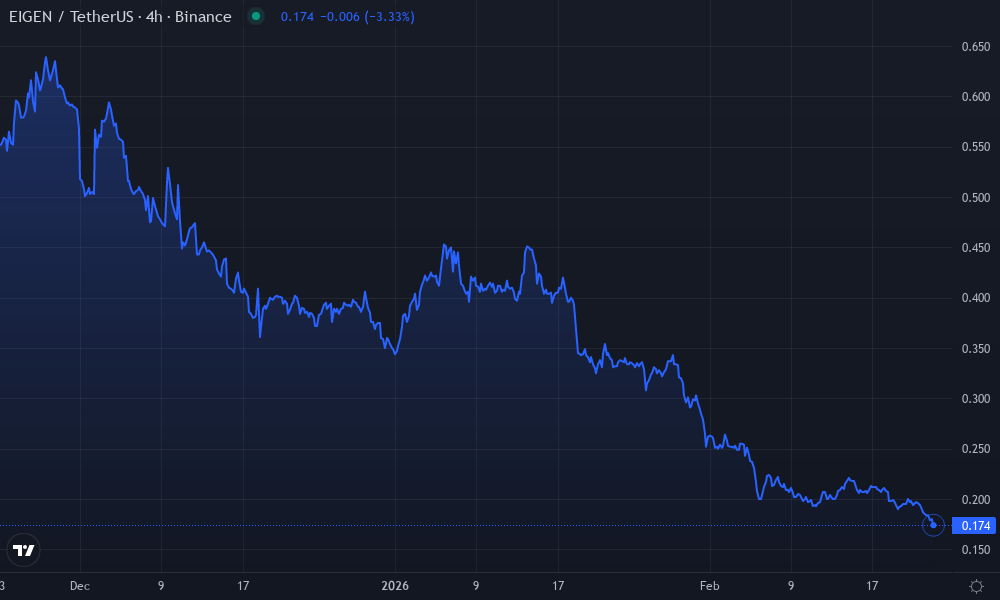
Analysis by Michael Brown | Symbol: BINANCE:EIGENUSDT | Interval: 4h | Drawings: 5
Technical Analysis Summary
As Michael Brown, with my hybrid approach blending technical patterns and EigenLayer's robust AVS ecosystem growth in 2026, draw a prominent downtrend line connecting the swing high at 2026-01-15 around $4.20 to the recent low at 2026-02-20 near $2.35, using 'trend_line' tool in red with 0.9 confidence label. Add horizontal support at $2.00 (strong, green), resistance at $3.00 (moderate, red). Mark entry short zone at $2.80-$2.90 with 'rectangle' light red, stop loss $3.10 'horizontal_line' orange, profit target $2.00 'horizontal_line' green. Use 'arrow_mark_down' at recent breakdown 2026-02-18 for bearish continuation. Highlight volume spike on downside with 'callout' noting 'distribution'. Draw fib retracement from high $4.20 to low $2.35, focusing 61.8% at $3.45. Add text box: 'Bearish bias short-term, watch AVS rewards v2 for reversal'. Use date_range for consolidation Jan 25-Feb 5.
Risk Assessment: medium
Analysis: Volatile downtrend but strong fundamentals from EigenLayer AVS/slashing; medium tolerance suits structured shorts
Michael Brown's Recommendation: Short bias with tight stops, monitor uptime leaderboards for reversal cues
Key Support & Resistance Levels
📈 Support Levels:
- $2 - Strong multi-touch low from prior swings, AVS security floor strong
- $2.35 - Recent lows holding as minor support moderate
📉 Resistance Levels:
- $3 - Key retracement resistance, prior consolidation high moderate
- $3.45 - Fib 61.8% retracement level weak
Trading Zones (medium risk tolerance)
🎯 Entry Zones:
- $2.8 - Bounce into downtrend line, volume confirmation for short medium risk
- $3.45 - Fib resistance rejection for short re-entry high risk
🚪 Exit Zones:
- $2 - Strong support target 💰 profit target
- $3.1 - Above recent high invalidation 🛡️ stop loss
Technical Indicators Analysis
📊 Volume Analysis:
Pattern: spikes on downside, divergence at lows
High volume confirms distribution, potential exhaustion nearing
📈 MACD Analysis:
Signal: bearish crossover with histogram contraction
Momentum weakening, watch for bullish divergence
Applied TradingView Drawing Utilities
This chart analysis utilizes the following professional drawing tools:
Disclaimer: This technical analysis by Michael Brown is for educational purposes only and should not be considered as financial advice. Trading involves risk, and you should always do your own research before making investment decisions. Past performance does not guarantee future results. The analysis reflects the author's personal methodology and risk tolerance (medium).
Tracking via AVS Leaderboard arms you with real-time edges. These top AVS operators 2026 aren't flawless, but their metrics deliver. Stake smart, uptime first, and watch yields compound in EigenLayer's maturing arena.


No comments yet. Be the first to share your thoughts!